Lecture Comments
Lecture 1 – Thoughts on ideas, Susanna Edwards
We have been using design methods since they were more formed in the 20th century when the Bauhaus started using their broad design methods. Is there elements of the Bauhaus thinking still present today? Could we still adopt and use this method or have the advancements of technology got in it’s way.
Design process today: Today’s design process is on a constant stream of change, having to adapt to the new ways of working, technology and us as humans in the way we work.
Do we as individuals have our own design model? and even do we have our own life models (in how we go about our daily lives alongside our practice)
Thinking to much: and thinking to little.
How am I feeling right now (Monday 28th June 2021) – Motivated to explore but also disconnected due to vertigo today. Intrigued into further reading about how we think, why we do what we do and the processes I take within my own practice.
We overload our brains with too much information from personal to work. We almost throw everything into our brain and try to make sense of it all. How do we as individuals deal with this information and process it. I like to make notes to empty my brain, speak to people about thoughts to let them out, sketch to get that idea out and down onto paper (it’s like simplifying it) I struggle to keep still and focus at times so the want to think to much is always present.
“Approach the issue at hand from all possible angles”
Edward De Bono

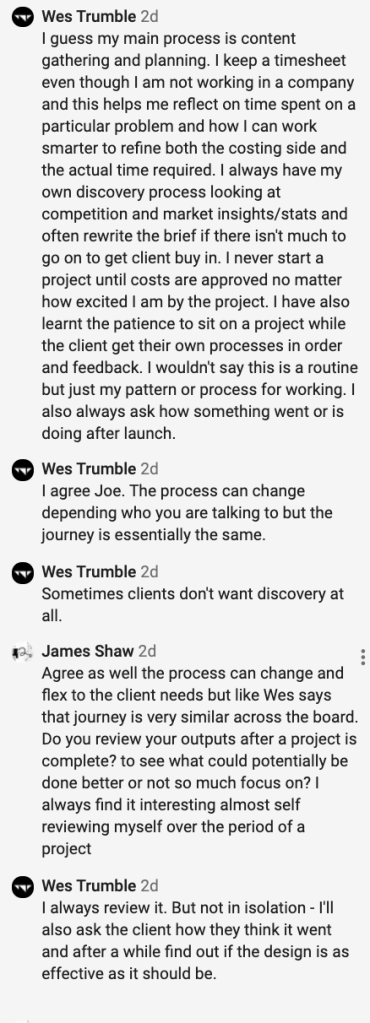
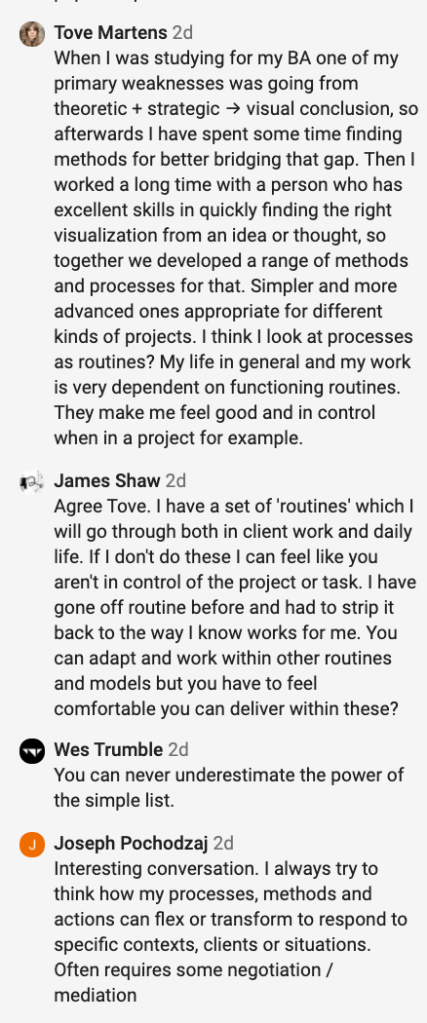

Design Development (weekly Challenge)
Jotting down my own thoughts on my design process within my practice but also my mental process and stage by stage process (of a brief)
Fluctuations come and go throughout projects and processes so how do we make room for these?
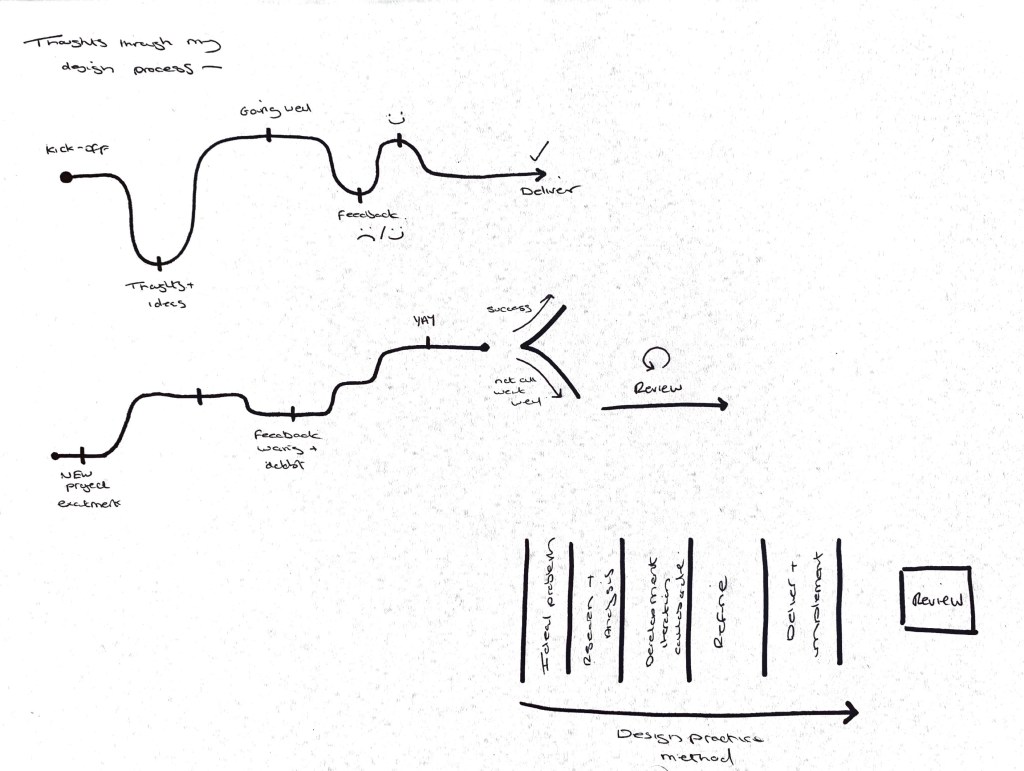
Quick sketch of my brain going from project kick off on the left (full of ideas buzzing around) to a more clear pin pointed delivery on the right (focussed and implemented) This doesn’t apply to every project that I do, as some have a more chaotic route or a much more streamlined route.

Chosen way of thinking – Divergent thinking
‘Thought process or method used to generate creative ideas by exploring many possible solutions’ in the opposite to convergent thinking which is a clear and defined answer found. This was coined by physiologist JP Guildford
Divergent thinking tends to be free flowing, non linear spontaneous & flexible. There doesn’t tend to be one right answer – its got multiple outputs. It’s all about seeing how creative you are as an individual.
A connection between ideas in web like structures.
To use materials in original ways.
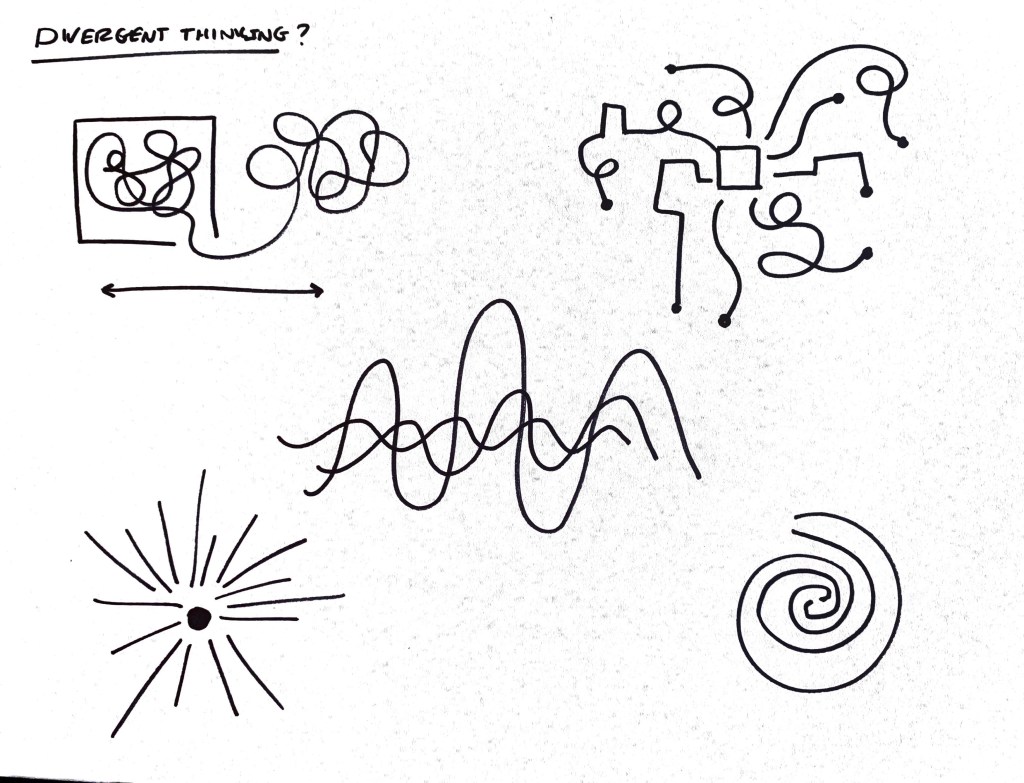
Sketching out my view on divergent thinking.
1(top left) out of the box, escaping the norm and trying something new.
2(top right) Many ideas which take all different routes using multiple different materials
3(middle) Waves of coming in and out of ideas, mistakes failures and successes.
4 (bottom left) Explosion of thoughts and ideas.
5. (bottom right) Continuation of thinking, generating, process, iteration.
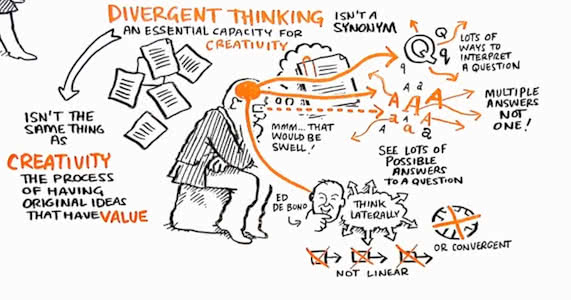
Sir Ken Robinson on Divergent Thinking:
“Divergent thinking is an essential capacity for creativity”
Sir Ken Robinson
If we always thought in a linear / convergent way would we be able to fulfil the design process? Divergent thinking gives us the opportunity to see multiple answers to a question so could this also potentially hinder the process? Could too many answers overwhelm?
Within a design process I think it’s key to be able to open your mind up to many possibilities and routes and see what can be achieved, leaving it open will allow for potential collaboration, investigation and intrigue to research, giving a richer journey for both the client and practitioner. Ken Robinson say’s “Divergent thinking isn’t the same as creativity” however I think there is an argument to say there is elements which are? Creativity is coming up with ideas, different routes and exploring new ways of working as well as physically working with materials and experimenting. While being ‘creative’ you are creating answers visually to a question / problem.
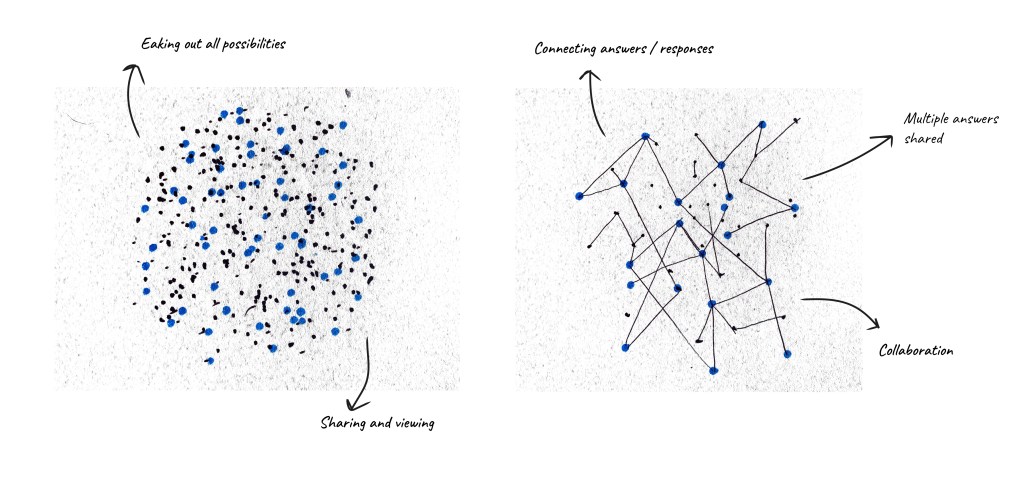
After reading about divergent thinking from Ken Robinson I went back and reviewed my initial sketches and produced further development. Both focussing more on this idea of multiple answers to a question, the ability to connect this answers, narrow them down, collaborate and visualise at once. A complex system of ideas which brings up many possibilities for the outcome.
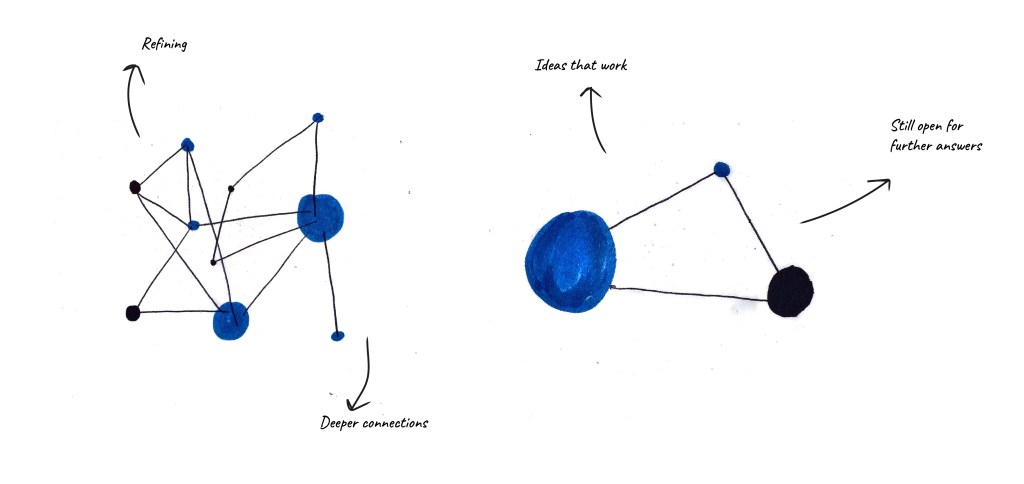
These complex outcomes can then be narrowed down to key ideas which stand out (visual below) moving through the design process
Chosen Thinker – Graham Wallas
“Happy Ideas come unexpectedly without effort, like an inspiration”
Graham Wallas
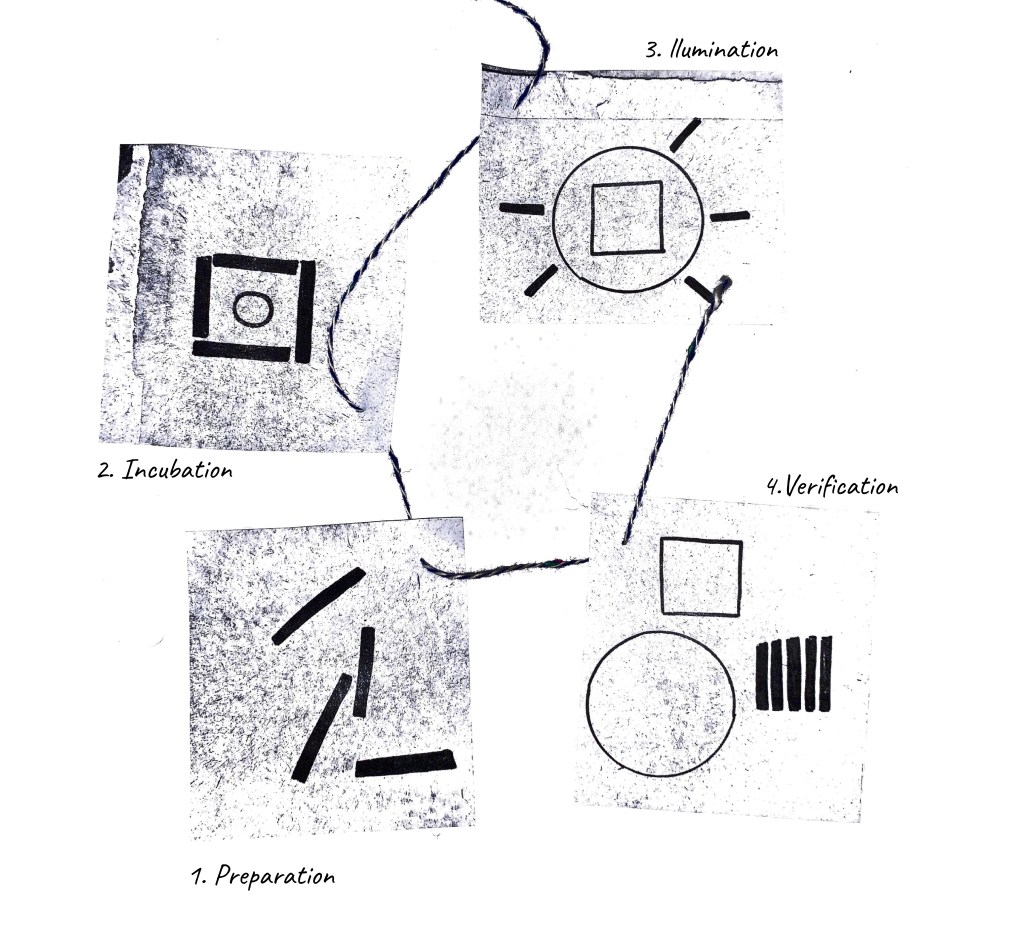
Graham Wallas wanted to uncover the ‘natural thought process’ of creativity within his last piece of work ‘The Art of Thought’ He set out 4 key stages he beleived were key to the creative thought process, these being:
– Preparation – Investigated in all directions
– Incubation – Not consciously thinking about the problem
– Illumination – Appearance of the ‘happy idea’
– Verification – Validity of the idea was tested, and the idea itself was reduced to exact form
reference – https://www.designreview.byu.edu/collections/graham-wallas-the-creative-process
Not so much different to the models and processes we see today however the way in which Wallas described and broke down each stage intrigued me. It sparked different ideas with the language use. Even though he outlines 4 key stages which are processes within themselves he says: “In the daily stream of thought these four different stages constantly overlap each other as we explore different problems” Highlighting the need for models adopted to flex when necessary in relation to the project.
Development of Line drawing:
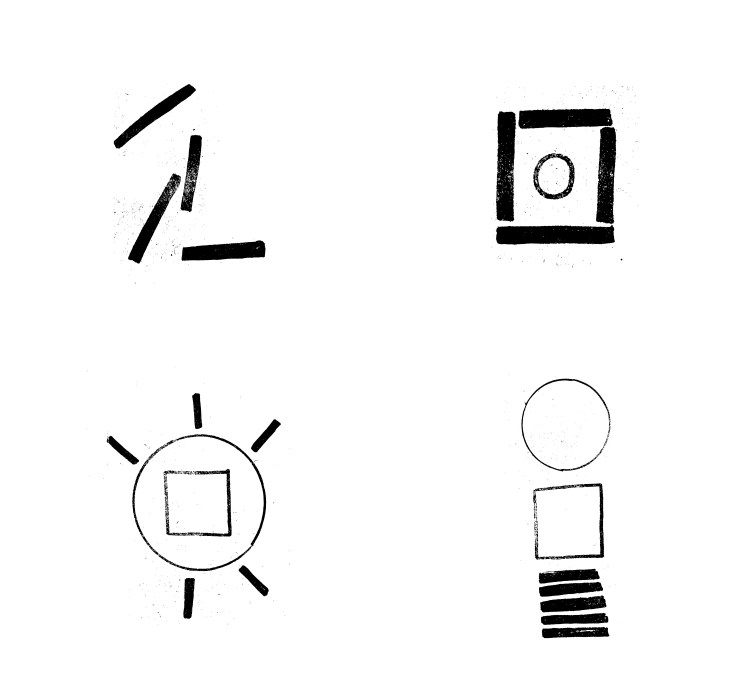
Graham Wallas said to be free with ideas and explore those that come naturally. I have started to explore how his creative process of preparation, incubation, illumination and verification can look through simple and clear shapes. I want to explore almost a journey within the process which is clear from beginning to end, I don’t want there to be words potentially, clear visual shapes.
Could I think about how this is shown? Instead of being just flat? where can I incorporate the element of overlap throughout, this isn’t a linear process.
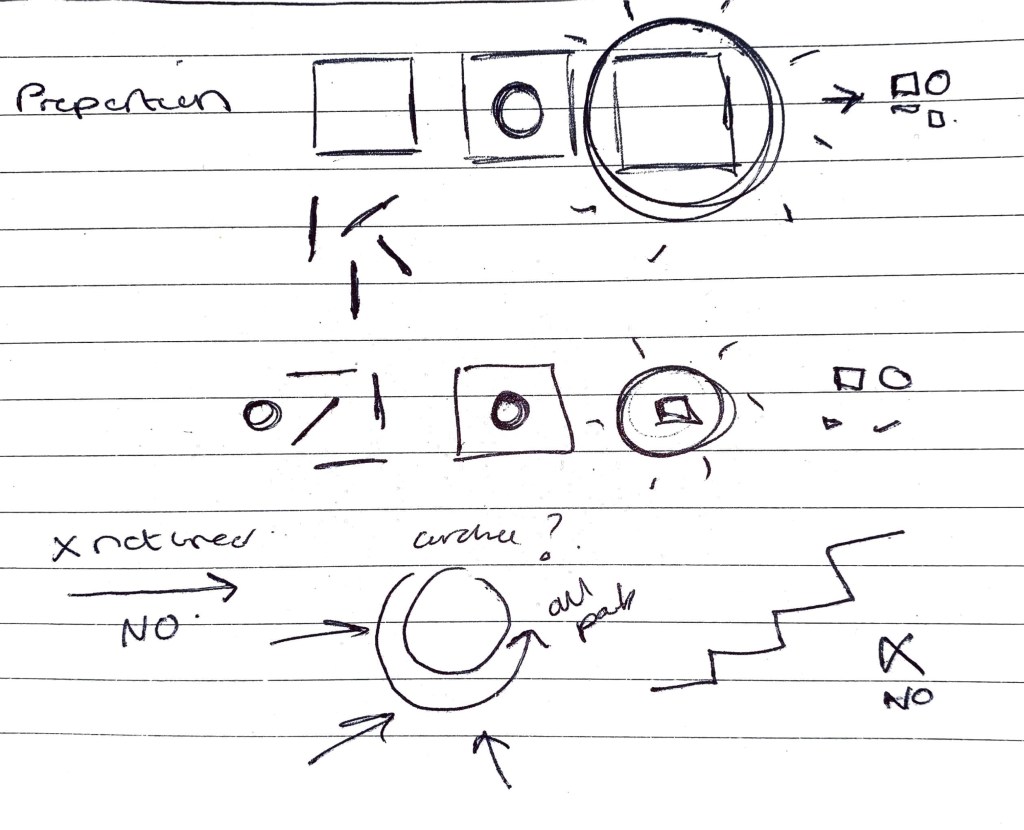
Further developing the line but thinking which way it should go, if in a straight line does it need to include rotations on each to show continual development can happen in each. Bottom right hand corner I am starting to explore how the ‘overlap’ can come into to play. Concise in one system which you can go back through and cross over, but still keeping 4 separate stages. Does this constrain the process too much? Is it too squeezed?
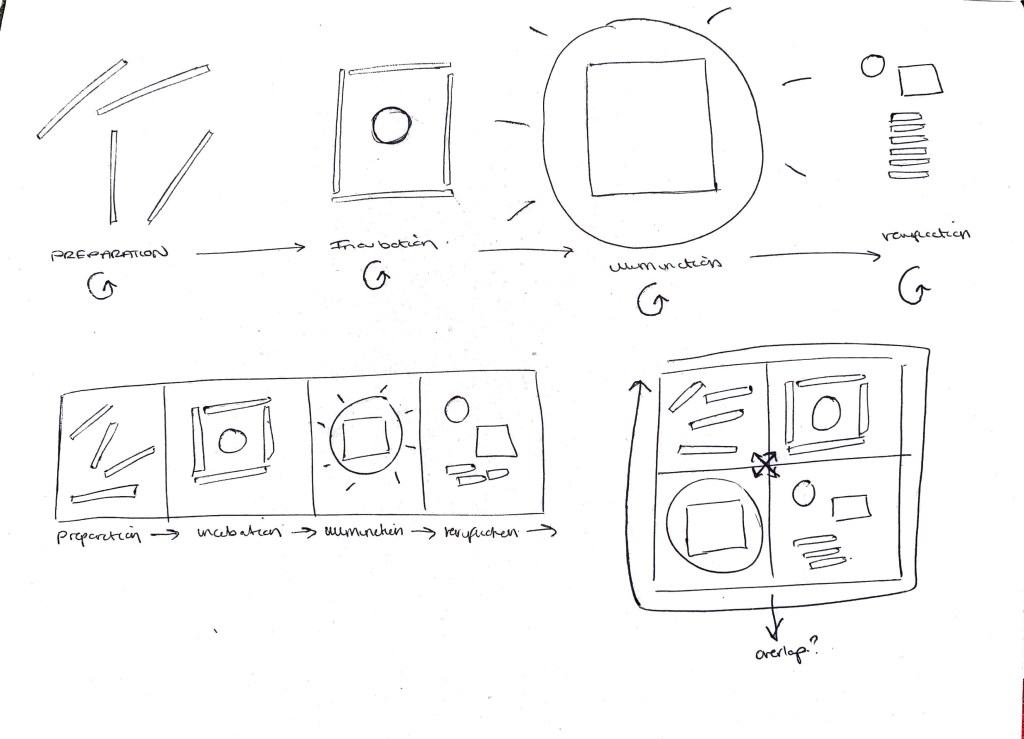
Pulling the elements apart. Starting to think how they could be displayed / constructed. Thinking about threading the elements together (3D) to show the tactile but also connectivity of all parts of the process? keeping in analogue form and avoiding working digitally, feel this would interrupt the creativity of the process? almost take away its meaning? Currently working with markers, paper and card.
On the right this is a developed sketch exploring the use of thread within the diagram. Connecting together the parts of the process so its an explorative process not step by step.
I really feel the piece should come to life off the page? Maybe hanging? or even 3D models for each? I feel on paper it works but to really explore that natural thought process it should go further. OR even a mix of elements.

Theories and process models:
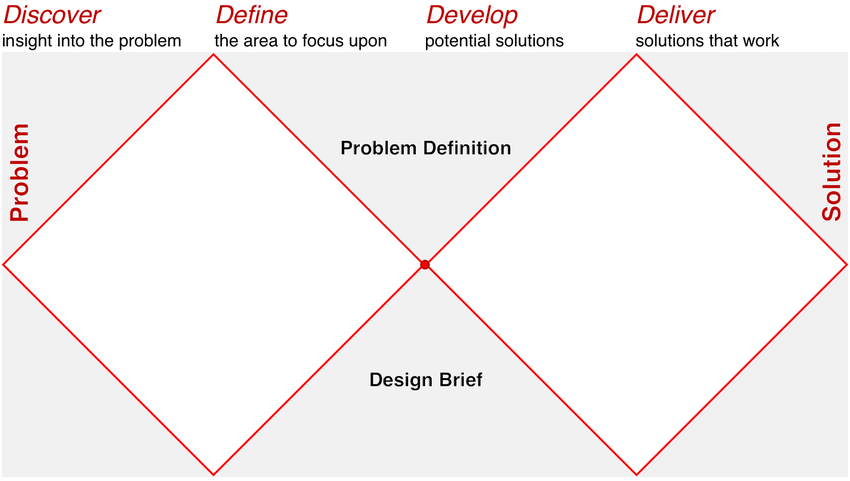
The Double Diamond Approach: Using both convergent and divergent thinking to expand and explore ideas in response to the problem to then focussing on solving. Then exploring again through developing the solution. Towards the delivery narrowing down and pin pointing the implementation of that final solution (this may span across multiple touchpoints)
Within my own practice there is elements within the double diamond approach I use, in particular those at the beginning of the process and once a direction has been decided. I however feel there is elements before the ‘problem’ such as engagement and conversation before getting into discussing the problem likewise at the end once delivered I engage further once implemented for feedback, results etc.
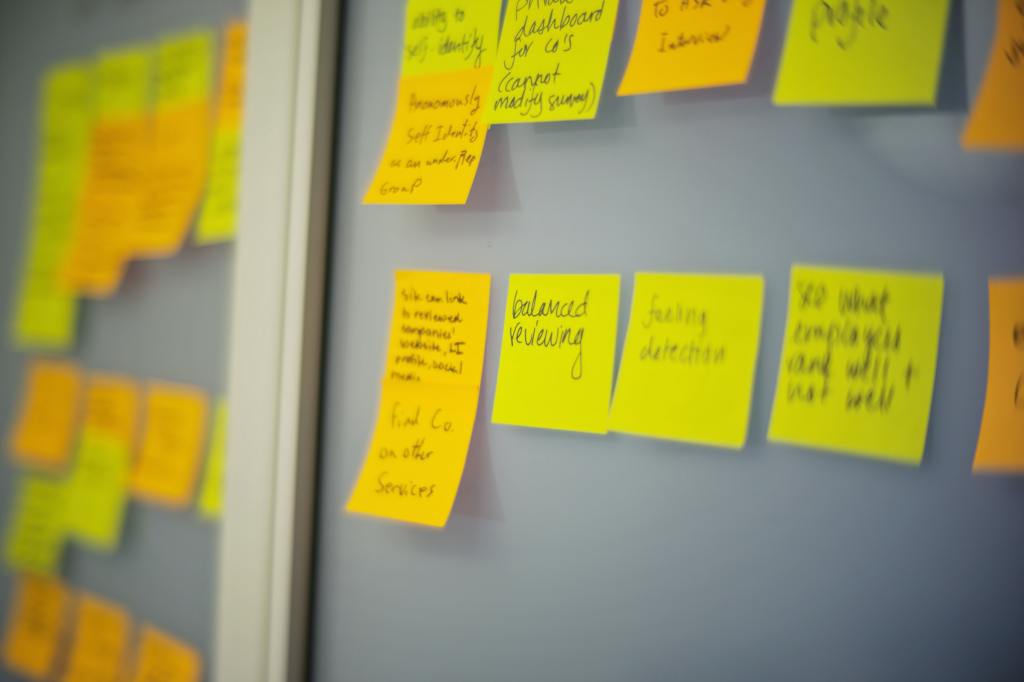
The simple process of brainstorming as an individual or as a team to generate ideas quickly, this also allows ideas to me moved around, grouped together and removed (using post-it notes for example)
Research
Eleven Lessons: Managing design in eleven global companies.
“Design processes are difficult to standardise, in part because of their iterative, no-linear nature, and also because the needs of clients and users are so different” – Best, 2006
Can we have a stand alone design process which underpins design but on the surface has different processes which flex with our clients? I know from my own experience that I have had to adapt and change my process due to the client or even my working methods. The same process doesn’t fit all like Best suggests above, we need to be adaptable and open but understand core design methods?
“Allot of designers seem to face one direction, which is clients paying me so I will do what the client says”
Neville Brody
Neville goes on to say that he feels they have responsibility towards the people who have to live with that. This brings up interesting conversations around going beyond the design process many might go by or have adopted from the past. Should we be looking further at both ends of the process to consider the client further? To really be part of their journey.
Sketch below – thoughts on either side of the design process.
Left side – Does the process start before project kick-off
Right side – Does the project go beyond delivery/ implementation/ application
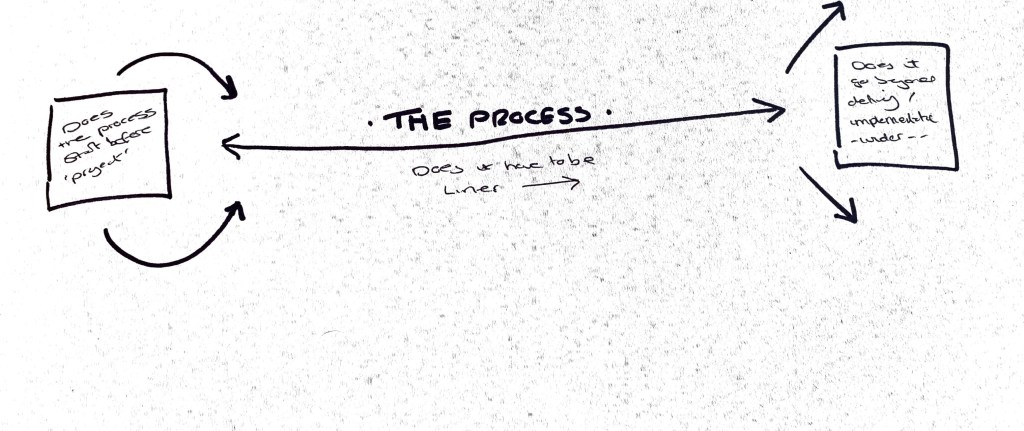

This for me has again taught me that we should be looking beyond the linear process of design. Within my practice to date I feel I have been quite constrained / linear which may be why a number of projects haven’t been as explorative as they could have been. Neville Brody talks of going beyond the delivery and I feel this is such an important part to establish yourself as a designer which engages and delivers.
Graphic Design Process : From Problem to Solution
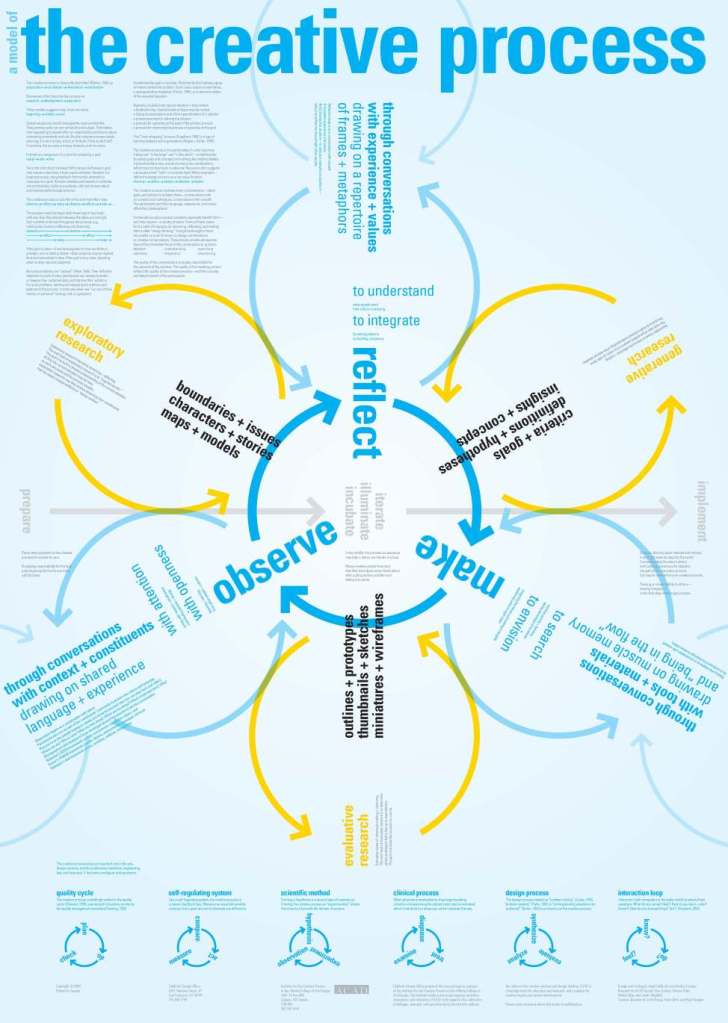
Eleven Lessons: Managing design in eleven global companies.
“Despite the extensive research undertaken since the 1950’s, there is no single model which is agreed to provide a satisfactory description of the design process”
Clarkson and Eckert
Clarkson and Eckert say there is no model which fits the description of the design process which I agree with, how can you a single defined design process when there is constant changes and challenge being throw into the design industry for example the advancement of technology. I do think however there could be an almost structure to the design process (like the double diamond) which can flex, expand and be broken to meet the client needs? It could then be imposed/stripped back for those clients who may be more or a challenge to work with? bring it back to a simple process so they can be involved.
Kenneth Martin
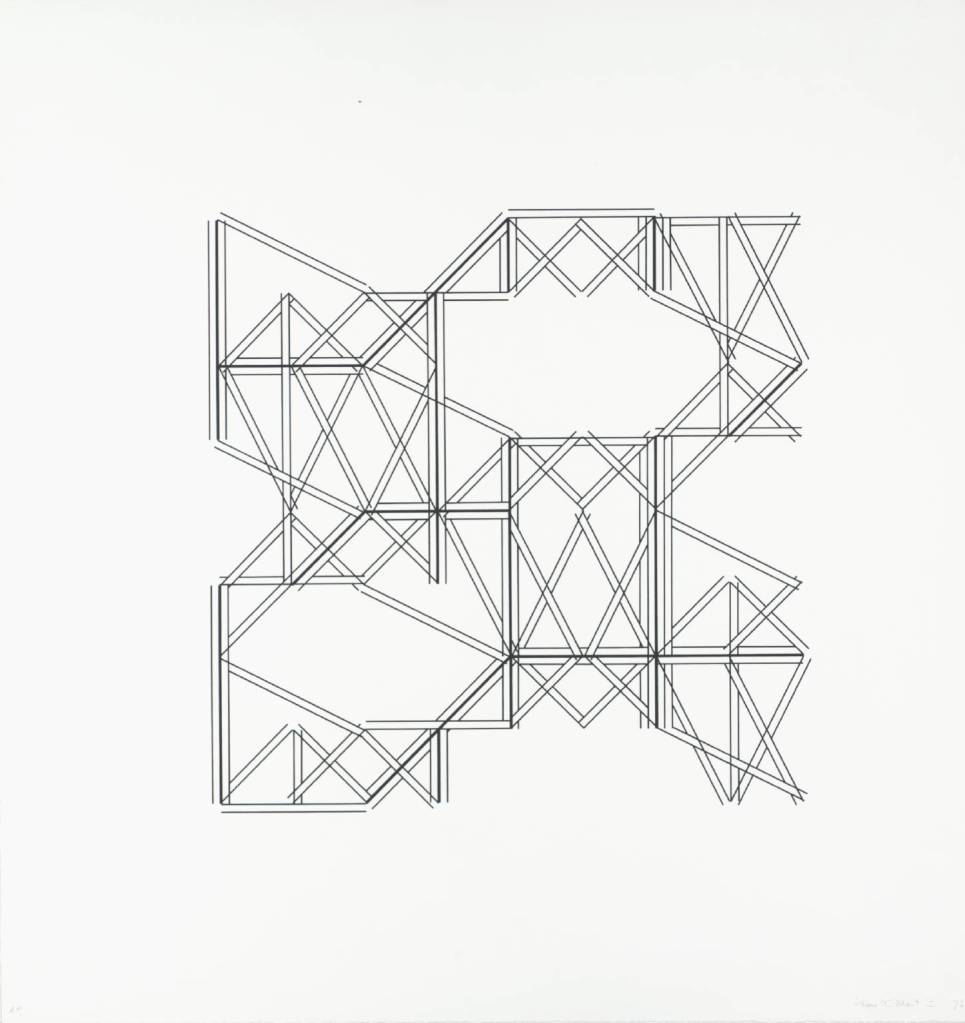

Images above sourced from: https://www.tate.org.uk/art/artworks/martin-chance-and-order-vi-p05377
Visual Inspiration for my weekly challenge has come from Kenneth Martin, and English painter and sculptor. Constructed forms and shapes creating abstract and structured compositions. For me these showed preparation and illumination of Graham Wallas’s design process. The simple forms can be interpreted in so many ways, with many routes and configurations available to the viewer.
Final Outcome
References
Divergent Thinking Ken Robinson. 2016. Directed by K. Robinson. Youtube: Robert Robinson.
What is graphic design … the process. 2016. Directed by D. Council. Youtube: Design Council.
The Tate. (2021). Chance and Order VI. Available: https://www.tate.org.uk/art/artworks/martin-chance-and-order-vi-p05377. [ Last accessed 2 july 2021]
Chris Mattson. (2021). Graham Wallas: The Creative Process. Available: https://www.designreview.byu.edu/collections/graham-wallas-the-creative-process. Last accessed 5 July 2021.
Weekly Critical Reflection
What went well this week: My exploration and freedom to create, this week I let go off the computer and tried to focus on what I was thinking to create in relation to this weeks task. I am starting to dive deeper into research and enjoy the process of investigation. I struggle to take information in when reading but have started to adapt my process to make it easier. This week I really enjoyed breaking down different processes and thinking about my own practice, learnt that there are so many different routes (however a core process) to generating ideas. The beauty of this is you can explore new ways that work for you.
Keeping working on: To pick and full respond to the resources provided I am interested in. I find myself getting going on the challenge first and stepping back at times. Sometimes I skim read the challenge and have to get my creative brain going with sketches.
Into next week: Look at how I could respond visually to parts of the resources? I think this might help me understand better and make the process even more enjoyable. I see myself as a visual learner so want to try getting my thoughts out that way.
Do a peer to peer discussion with another student to get feedback on my weekly challenge or a question which may arise. Continue to explore opinions outside of the course and bring those in.
 James Shaw